
Carbondale Criminal History Checks
Carbondale Police is the first stop for an incident investigated by town officers. Its records form covers police and accident reports, body-worn video, and other specified material. A town citation or ordinance charge belongs with Carbondale Municipal Court. An arrest followed by detention appears through Garfield County Jail, while a state criminal prosecution appears in the Ninth Judicial District docket. CBI's Internet Criminal History Check supplies a Colorado-only name-based record from data CBI holds.
- Identify the event location and confirm that Carbondale Police handled it.
- Send the town records form with the report number, date, location, and requested material.
- Call the Municipal Court clerk for town-code, traffic, or local misdemeanor records.
- Check Garfield County custody and court systems for a booking or filed state charge.
- Use the official CBI channel when the question concerns Colorado criminal history beyond Carbondale.
Each step answers a different question. A police narrative does not establish the final court outcome, and a county jail entry does not show every detail in the town's investigative file.
Requesting Carbondale Police Reports
The English and Spanish forms center links a Records Request and a separate Body Worn Camera/Digital Evidence Request. The records form asks for the requester's signature and date, name and telephone number, report number, incident date, nature and location, involved parties and dates of birth, the requested documents, and a delivery choice. Available delivery choices are mail, email, fax, or pickup. Document checkboxes distinguish a police report, accident report, body-worn video, and other material.
Send the completed request to cpd@carbondaleco.net, fax it to 970-963-3802, mail it, or take it to the counter. Carbondale asks requesters to allow three business days and requires prepayment by cash or check. Specific event details matter. Broad requests can slow the search and make it harder to separate one Carbondale criminal record from another.
| Carbondale Product | Posted Charge |
|---|---|
| Accident report | $10 |
| Record search | $10 |
| Report pages | $0.25 per page after the search fee |
| Personnel time | $20 per hour |
Records at the Carbondale Police Department
Carbondale Police operates from Town Hall at 511 Colorado Avenue, Suite 911, Carbondale, CO 81623. The telephone number is 970-963-2662, and the counter is open weekdays from 8 a.m. to 5 p.m. After hours, shared dispatch is reached at 970-625-8095. The department maintains town police reports and related evidence. It is separate from GCSO even though a Carbondale arrestee may later enter the county jail.
The official department page provides the current records and service route. The following image comes from the Carbondale Police Department.
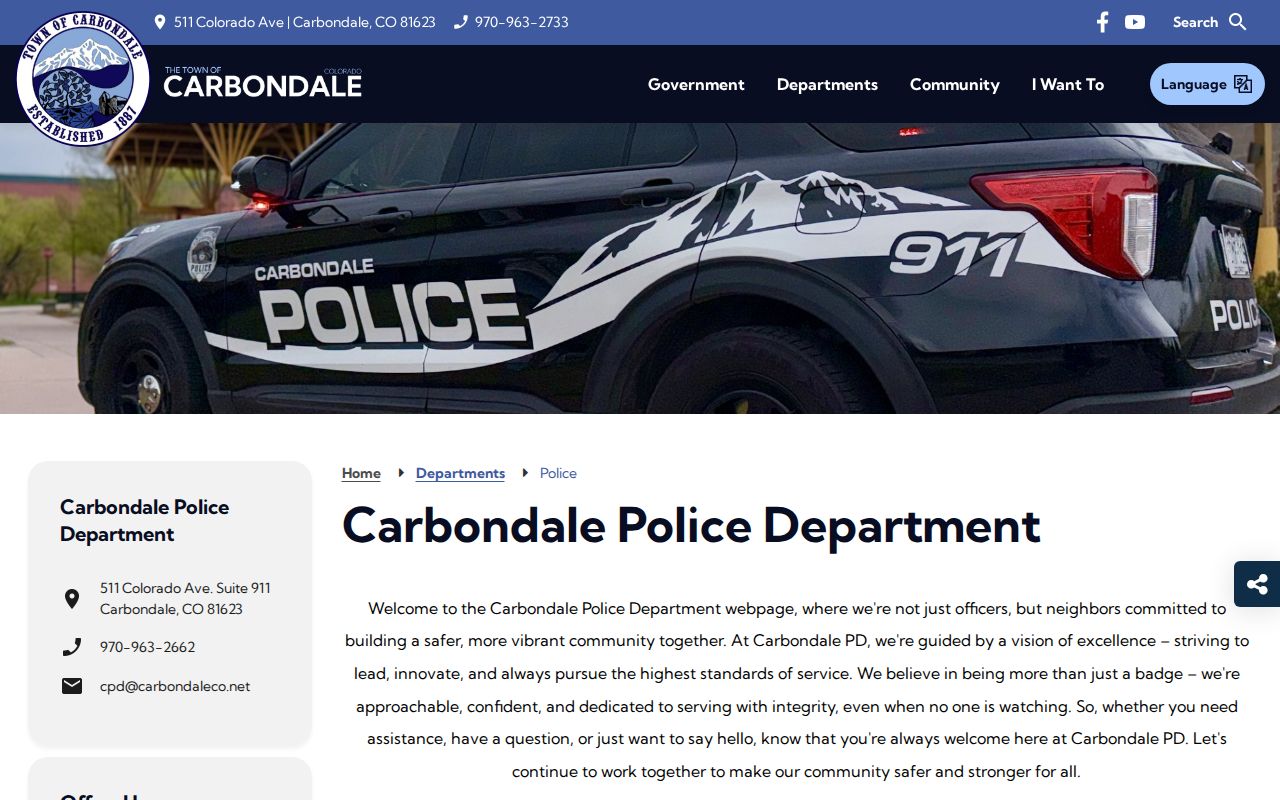
The source should be checked before a visit because forms, staff directions, and service details can change.
Carbondale Police
511 Colorado Avenue, Suite 911
Carbondale, CO 81623
970-963-2662
Weekdays 8 a.m.-5 p.m.
cpd@carbondaleco.net
Carbondale Police Owns Its Reports
A $5 Garfield County Sheriff's Office clearance check covers only GCSO records. It does not include an incident held by Carbondale Police. The same custodian rule applies even after the county jail books a person arrested by a Carbondale officer. The town retains its narrative and evidence, GCSO retains booking and custody data, and the court retains filed charges and outcomes.
This distinction prevents a common false conclusion. A blank sheriff clearance does not prove that Carbondale has no police record. Ask which agency created the report. If an event occurred on Highway 82, also confirm whether Carbondale Police, GCSO, or Colorado State Patrol responded. Shared dispatch does not merge those agencies' files.
Booking and Arrest Records in Carbondale
Carbondale does not supply the county's main custody roster. A person arrested by town police is ordinarily transported to Garfield County Jail at 107 8th Street in Glenwood Springs. GCSO's Current Inmates report refreshes every two hours and can show current custody, recent arrests, and recent releases. Time-sensitive confirmation belongs with jail staff by phone because the report can lag the live event.
The booking file can contain commitment date, booking number, listed charges, bond, demographics, and release status. Carbondale Police keeps the probable-cause or incident narrative. If prosecutors file a state charge, the Judicial Branch docket becomes the source for filed counts and disposition. Those charges can differ from the allegations displayed at booking.
After release, the person may disappear from the current roster while the Carbondale police report and court file remain. For historical custody, request the booking information from GCSO. For a state prison sentence, switch to CDOC Find an Inmate. For a federal matter, use the federal docket and federal custody systems.
Four Stops in a Carbondale Arrest
A Carbondale arrest can leave four records at different speeds. The town report starts with the officer. The jail file begins at intake in Glenwood Springs. A court file begins if the prosecutor files charges. Fingerprints and identifying data sent to CBI establish or update the Colorado arrest cycle. A searcher should not expect all four sources to match on the same day.
Local arrest flow: Carbondale Police › Garfield County Jail › Ninth Judicial District Courts › Colorado Bureau of Investigation
- Arrest charge
- The allegation recorded by police at the enforcement stage.
- Booking charge
- The charge shown when the jail receives the person.
- Filed count
- The charge the prosecutor places in the court case.
- Disposition
- The court outcome, such as dismissal, acquittal, deferred judgment, or conviction.
When the charge names differ, rely on the court for what was prosecuted and how it ended. An arrest alone does not prove guilt.
The Carbondale Municipal Court File
Carbondale Municipal Court hears traffic matters, criminal misdemeanors, animal, noise, speed, and other ordinance cases arising within town limits. Sessions are generally held on specified Tuesdays near 4:30 p.m. in Town Hall Room 1, and the town links proceedings to YouTube. No general public name or case-search portal was identified. The correct lookup route is the court clerk.
| Court Name | Carbondale Municipal Court at Town Hall |
|---|---|
| Case Types | Town traffic, criminal misdemeanors, animal, noise, speed, and ordinance matters |
| Lookup Channel | Clerk Patrick Thibault at 970-510-1206 or pthibault@carbondaleco.net |
| File Contents | Citation, hearing events, plea or judgment, fines, payment status, and orders when public |
| Payments | Cashier, telephone, mail, or exterior night utility depository |
A citation cell number can receive monthly reminder texts until judgment. Fine-assessment payments are accepted at the cashier on weekdays from 8 a.m. to 5 p.m., by telephone at 970-510-1201, by mail, or through the night depository. Payment options are not a public case-search service.
Municipal Court or Garfield Court?
The court depends on the charge. A Carbondale ordinance, eligible town misdemeanor, or local traffic matter can remain in Municipal Court. A state misdemeanor, felony, or preliminary felony matter belongs in Garfield County Court or District Court. Carbondale-area County Court matters generally route to Glenwood Springs under the current residence-based venue order.
| Record Question | Carbondale Municipal Court | Garfield Combined Court |
|---|---|---|
| Town ordinance | Primary file | Usually not the file |
| State misdemeanor | Not the state prosecution | County Court |
| Felony | Not the felony court | District Court |
| Public lookup | Call or email clerk | Colorado docket, then clerk request |
If the Colorado Judicial docket has no match, do not assume the Carbondale case never existed. Call Municipal Court. Conversely, a town clerk cannot provide the complete District Court felony file.
How Carbondale Records Reach the County
Carbondale Police sends arrest fingerprints and identifying data through the criminal-justice system, while prosecutors decide what to file. Garfield courts become the authoritative source for hearings, motions, pleas, dismissals, judgments, and sentences in state cases. Courts and other agencies report dispositions back to CBI, though CBI warns that a criminal history can contain an arrest with an unknown or missing disposition.
Record flow: Carbondale Police › Garfield County Courts › Colorado Bureau of Investigation
For a recent event, start with Carbondale Police and the county jail. For a filed case, use the Garfield County court case lookup. For a broader Colorado-only history, use CBI ICHC with its name-match limits. If CBI lacks the disposition, obtain the court's official outcome and follow CBI's update or challenge procedure.
Carbondale Crime Data by Agency
Carbondale crime totals should come from the official Colorado Crime Statistics portal with Carbondale Police selected as the reporting agency and a complete calendar year chosen. No unsupported count should fill a gap. Arrest totals, offenses, calls, and incidents are different measures, so the selected chart and year must remain attached to any number.
This agency filter matters along Highway 82 and elsewhere near town. Colorado State Patrol, GCSO, and nearby police agencies may create records for events that feel local but do not belong to Carbondale Police. A Carbondale agency total therefore measures reports assigned to that agency, not every public-safety event near the postal address.
Carbondale is an incorporated town and the third-largest incorporated place in Garfield County by the research ranking. Its position between Glenwood Springs and the upper Roaring Fork Valley makes precise agency selection more useful than a broad place-name search.
Carbondale Record Access Rules
Police records follow the Colorado Criminal Justice Records Act. A custodian can review and redact juvenile or victim identifiers, protected personal data, active-investigation material, and security-sensitive video. The Carbondale form includes the statutory affirmation against using criminal-justice records for prohibited direct business solicitation. General public records may fall under CORA, but a general town request does not replace the police form.
Key statutes:
C.R.S. §§ 24-72-301 through 24-72-309 govern access to criminal-justice records and permit lawful review, redaction, and denial.
C.R.S. § 24-72-305 addresses inspection and categories of mandatory or permitted denial.
C.R.S. § 24-72-305.5 restricts obtaining records for prohibited direct business solicitation.
C.R.S. §§ 24-72-701 through 24-72-710 provide Colorado's adult record-sealing framework.
Ask for the specific report, video, citation, or court document needed. A denial or redaction of one item does not mean every related Carbondale record is closed.
Sealing a Carbondale Case
A dismissal does not erase the police report, booking, and court file at the same moment. Colorado chiefly uses record sealing for qualifying adult matters. The correct court depends on where the case was filed. A Municipal Court matter begins with that town court, while a state case begins in Garfield County or District Court. Eligibility depends on the exact outcome, offense, elapsed time, and current statute.
Start by obtaining the court disposition and reviewing one's CBI record. Use the current Colorado Judicial “Seal My Case” forms and the correct statutory route. After an order is signed, confirm that the court and affected agencies processed it. Automatic sealing also may not update every database at once. CBI ended its former fee for processing adult sealing orders in 2024, although court filing and copy costs can remain.
Carbondale's Town Records Context
Carbondale was platted in January 1887 and incorporated in 1888 after the arrival of the Colorado Midland and Denver & Rio Grande railroads. Agriculture stayed central even as nearby coal, coke, marble, and hard-rock industries shaped the region. Today the town is also known for arts, recreation, and its location near the Roaring Fork and Crystal rivers beneath Mount Sopris.
That geography helps explain the layered record path. A town officer can create the first report, a trip to Glenwood Springs creates the county booking, a state charge enters the Ninth Judicial District, and CBI receives the statewide cycle. Local history does not change custody rules, but it makes the Carbondale name alone an unreliable way to identify the correct modern agency.